Asteroids: A New Horizon
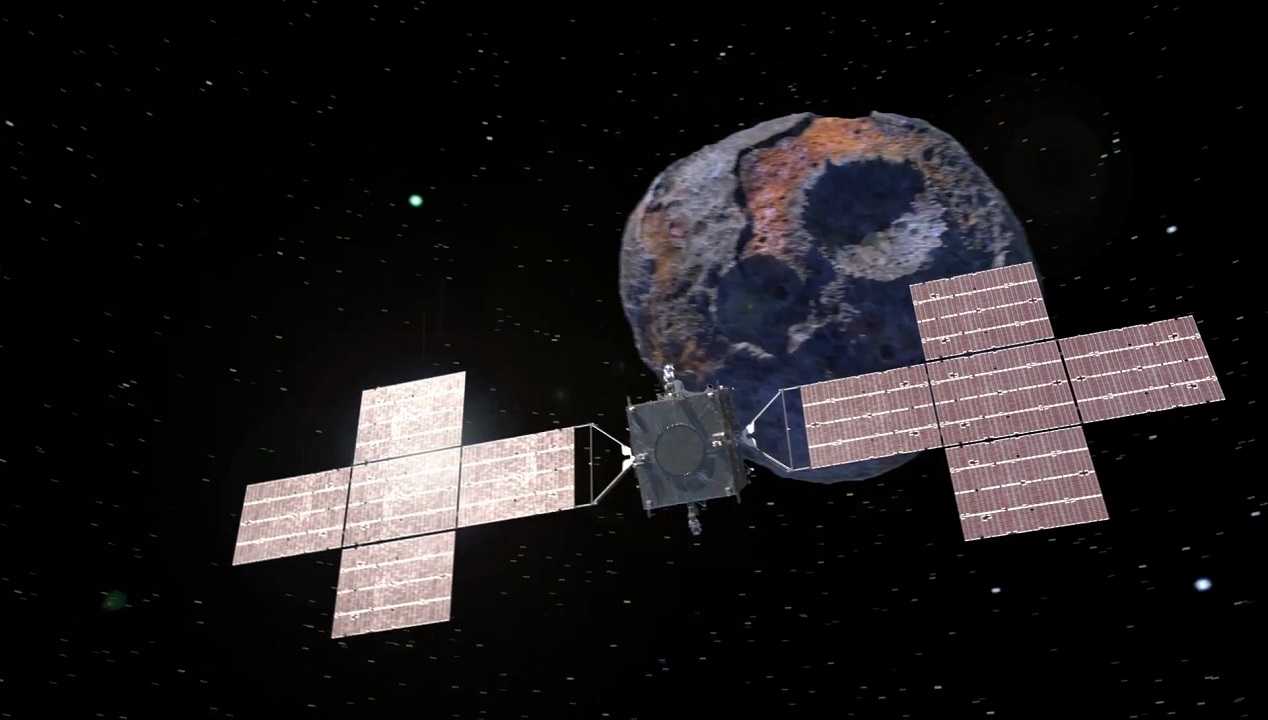
- Title: Asteroids: A New Horizon
- Duration: 2 × 60’ HD
- Producer: Spain
- Year: 2021
Episode 1: Exploring The Asteroids
We are about to witness how asteroids, those rocky abundant small and mysterious celestial bodies, could become into a new frontier for the human being in the near future.
There are several reasons why it’s interesting to explore and study them: the asteroids are remnants of the very remote past of the Solar System so they could help us to understand better about the formation of the planets as well as the origin of life; they are a menace to the Earth as they might impact causing catastrophic consequences, so we should track them and identify the most hazardous ones; they could be used as pit stops for future deep space exploration as they could provide us with valuable resources as metals or water, that could be used to produce propellant.
All these asteroids are in the Solar System, however there are asteroids beyond it. In fact, on October 2017 a shocking discovery was made: the Oumuamua, the first interstellar object was detected. It was the first time ever that a celestial body coming from another star system came so closed to the Earth.
Since the very first flyby close to an asteroid back in 1991 when NASA’s Galileo probe passed by the asteroid Gaspra, several missions have deeply explored them. Some of those missions orbited and studied them, like the NASA’s Dawn mission, that revealed us the secrets of the two biggest asteroids in the Main Asteroid Belt, the protoplanets Vesta and Ceres; some other missions were able to touch them, like the NASA’s NEAR Shoemaker, or the ESA’s Rosetta; or even some of them touched them and were able to return samples of asteroidal material to the Earth, like the JAXA’s Hayabusa 1 and 2 or as it is supposed to do so the NASA’s OSIRIS-Rex mission.
Episode 2: The Next Frontier
The prospect of asteroid mining, long the stuff of science fiction, is now being likened to a 21st-century gold rush. There’s a quest for resources among the stars, and asteroids are the prime targets, either for the metals they contain that could influence Earth-bound commodity markets, or for the water inside them that can be distilled into rocket fuel for future missions into deep space.
The first goal would be to detect which are the most valuable asteroids in terms of mining. resources. The companies are taking advantages of all the data gathered by missions to the Near-Earth Asteroids, like Hayabusa 1 and 2, OSIRIS-REx...
The second one would be to decide which would be the best way to mine, if they should bring asteroidal material to Earth for use or process on-site to bring back only processed materials and perhaps produce propellant for the return trip.
The third one would be to develop the in-situ mining techniques. The most advanced nowadays is the optical mining, which uses the solar energy to split the water into hydrogen and oxygen to obtain propellant. However there are other in-situ techniques that are been developed like the surface mining, the shaft mining or the magnetic rakes for metallic asteroids.
And the fourth and most important one would be to check the feasibility of the asteroid mining. The point would be to reduce radically the cost of space missions to make it really feasible.
In the near future, if this industry finally grows, it would likely imply the development of a transcontinental railroad of space. Humanity would become a spacefaring species homesteading the solar system, so some companies would have an ultimate goal of turning thousands of asteroids in refueling stations for NASA and commercial spacecraft opening the high frontier to NASA human exploration and commercial industries beyond imaging satellites and telecommunications. and of supplying services for the 21st century industries of asteroid mining, space solar power, space tourism and manufacturing in space.
The most important asteroid mining companies nowadays are TransAstra and OffWorld, as Deep Space Industries and Planetary Resources, the two previous leading ones, are now in a process of transformation as they have been absorbed by bigger companies.
TransAstra is focused in the optical mining technique and in the development of a wicky autonomous spacecraft, the Honey-Bees, which would be used to access to the asteroids and to mine their water to produce propellant.
Off-World is focused in the development of robotic devices that will mine for us autonomously. They see a new generation of industrial robots as the key enabler of human expansion beyond our home planet. They have developed robots that could mine, manufacture and build the Moon, asteroids and Mars, robots that should be small and robust, solar electric, autonomous and fast learning and with self-replication capability).
There is another company that is also targeting to the asteroids but not developing mining techniques, Atem Engineering. Their goal is to provide technical solutions in the areas of detection, discovery, follow-up and characterization of Near Earth Asteroids, with the aim of enabling in-space resource extraction and utilization to pave the way for Human exploration of the Solar System.
There is a small country in the center of Europe that has invested very hard in this emerging asteroid mining industry: Luxemburg. This tiny state is one of the world’s leaders in the NewSpace industry and specially in the satellite sector, but it’s now diversifying its financing support into more risky space industries as the asteroid mining.